49 Licensed Clinical Social Worker (LCSW)
Everything to Know about a Career as an LCSW
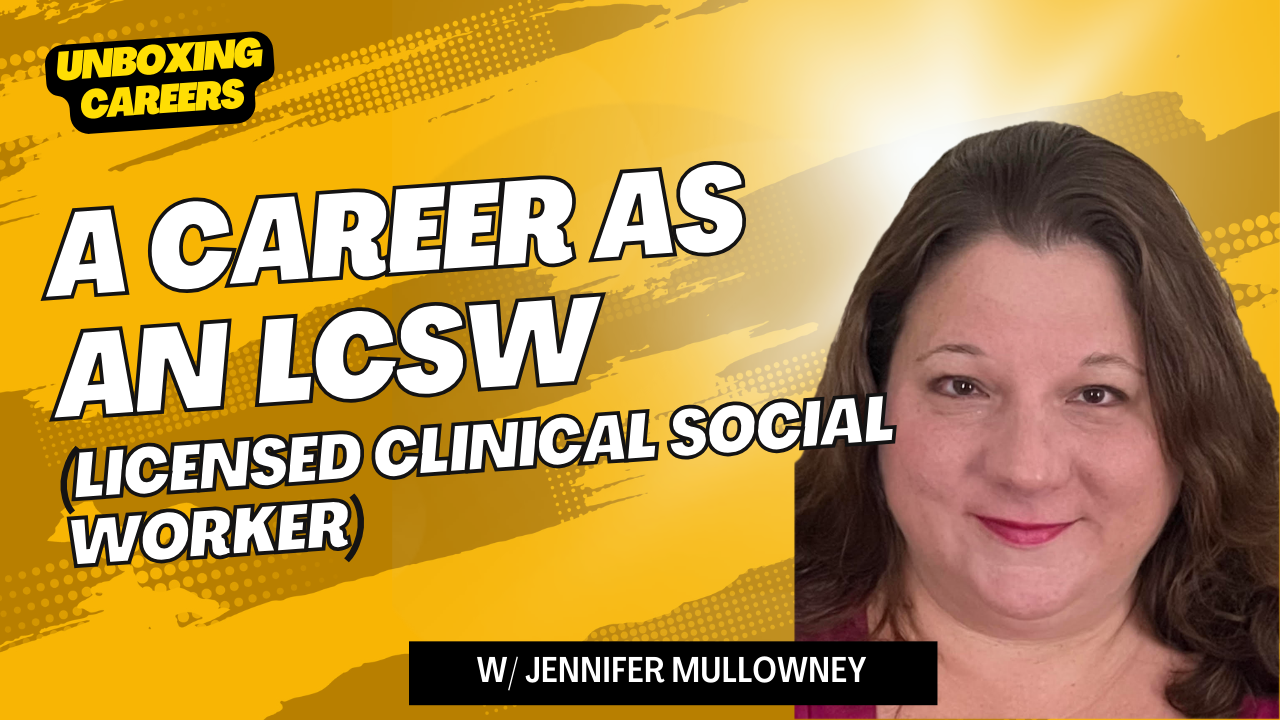
Guest: Jennifer Mullowney is a Licensed Clinical Social Worker with over 25 years of experience in the mental health field. Before working in outpatient mental health, she conducted mobile therapy for adolescents, worked in a residential treatment facility, and worked in an elementary school. Jennifer currently owns her own solo practice where she provides telehealth services to adults and couples. She specializes in treating depression, anxiety, grief and loss, career counseling, family conflict, and women's issues.
Connect with Jennifer:
Listen: Spotify | Apple Podcasts | Amazon Music
What Does a Licensed Clinical Social Worker (LCSW) Actually Do?
If you have ever wondered what it is really like to be a therapist, this episode of the Unboxing Careers podcast gives a real behind-the-scenes look. We spoke with Jennifer Maloney, a Licensed Clinical Social Worker, who works with adults and couples in private practice.
Jennifer currently sees adults aged 18 and up. Earlier in her career, she worked with teens, children, and families, but over time, she realized she especially enjoys working with adults, including young adults right out of college. Her clients often come to her for support with anxiety, depression, grief, life transitions, relationship challenges, and even family estrangement.
If you are in high school and interested in psychology or helping professions, this career allows you to support people during some of the most meaningful and difficult moments of their lives.
Common reasons people seek therapy include:
Anxiety
Depression
Grief and loss
Relationship challenges
Life transitions
Family estrangement
Why Choose a Career as a Licensed Clinical Social Worker?
Jennifer shared that every aptitude test she ever took pointed her toward a “helper” profession. In college, she majored in sociology because her school did not offer a social work degree. During an internship with a foundation focused on preventing child abuse, a mentor encouraged her to pursue a Master of Social Work degree because of its versatility.
That versatility is one of the biggest advantages of this path. A social work degree does not lock you into just one setting.
With an MSW, you can:
Work as a therapist in private practice
Work in hospitals or medical settings
Work in schools
Work in community or government roles
Shift between clinical and administrative positions
If you are in college and unsure about committing to one narrow career, social work offers flexibility. Jennifer emphasized that you can move between roles depending on your interests and life stage.
What Education Do You Need to Become an LCSW?
Jennifer went directly from college into a Master of Social Work program. After earning her degree, she completed two years of supervised clinical experience before becoming fully licensed.
Looking back, she said that if she could do it again, she might choose a bachelor’s degree in social work or counseling psychology instead of sociology. Those programs often introduce clinical skills earlier and provide stronger preparation for graduate school.
Here is a general path based on her experience:
Earn a bachelor’s degree, ideally in social work or counseling-related fields.
Complete a Master of Social Work program.
Finish approximately two years of supervised clinical work.
Pass licensing requirements to become an LCSW.
If you are in high school, start by exploring psychology courses, volunteering, or internships that expose you to different populations. In college, choose internships carefully. Jennifer stressed that internships are critical. You are paying for that experience, so you should evaluate the site just as much as they evaluate you.
What Skills Make Someone a Great Therapist?
Being a therapist is not about giving advice. It is about listening, understanding, and being fully present.
Jennifer highlighted several essential skills:
Active listening
Empathy
Strong communication
Ability to separate your own opinions from your client’s needs
Willingness to seek supervision
Emotional self-awareness
Empathy is especially important. You must be able to understand and validate someone’s feelings, even if their experiences are very different from your own. Sometimes empathy is expressed through simple statements like, “That sounds really hard,” or “I’m sorry you’re going through that.”
If you are in high school and you are the friend everyone goes to for support, that could be a sign this field fits you. Jennifer mentioned that no one was surprised when she became a therapist because she had always been that person in her friend group.
Where Do Licensed Clinical Social Workers Work?
You typically do not jump straight into private practice after graduate school. Jennifer recommends joining a group practice first to gain experience and learn how the business side works.
Entry-level roles might include:
Residential treatment centers
Hospitals
Schools
Government agencies
Correctional facilities
Outpatient clinics
Jennifer’s first graduate internship was in a correctional facility and drug and alcohol program. Although it was intimidating at first, she described it as one of the best clinical experiences she could have asked for.
Her advice is simple. Do not limit yourself too early. Be open to different age groups and populations. The experience you gain in one setting will help you in another.
What Is a Typical Day Like for an LCSW?
Jennifer currently sees between 15 and 20 clients per week, which she considers her ideal balance. In the past, she has seen closer to 30 clients per week when working full time.
Sessions usually last between 53 and 60 minutes, depending on insurance coverage. After each session, she completes clinical notes, which typically take five to fifteen minutes.
Her weekly schedule often includes:
Morning appointments
A short midday break
Evening sessions, sometimes until 9:30 PM
Sunday sessions, with Fridays and Saturdays off
One practical tip she shared is to stay on top of documentation. Do not let notes pile up. It is much easier to complete them while everything is still fresh in your mind.
If you are considering this career, understand that flexibility is a major advantage. However, many clients prefer after-work hours, so evenings are common.
What Are the Biggest Challenges?
One of the biggest challenges is unpredictability. You never truly know what a client might bring into a session. You have to be prepared to hear anything and avoid making assumptions.
Other common challenges include:
Emotional intensity of sessions
Managing your own reactions
Avoiding burnout
Balancing work and family life
Handling insurance and administrative tasks
Jennifer also emphasized the importance of self-care. After emotionally heavy days, she gives herself time to decompress before fully engaging with her family. If you are in college and considering this path, remember that mental health professionals must take care of themselves to care for others.
Is an LCSW Career Rewarding?
For Jennifer, the most rewarding moments are when clients express gratitude or when she sees them making meaningful progress. Watching someone grow and move forward in their life is incredibly fulfilling.
Therapists sometimes experience imposter syndrome early in their careers, wondering if they are truly helping. Over time, experience builds confidence.
Some of the most meaningful rewards include:
Seeing clients grow and improve
Helping someone through a difficult transition
Building strong therapeutic relationships
Making a real difference in someone’s life
If you are motivated by helping others and having meaningful conversations, this career can offer both purpose and flexibility.
Should You Consider Becoming an LCSW?
If you are in high school and drawn to psychology, communication, and supporting others, becoming a Licensed Clinical Social Worker could be a strong fit. You will need advanced education, emotional resilience, and strong listening skills. In return, you gain flexibility, meaningful work, and the opportunity to positively impact people’s lives.
In college, focus on developing communication skills, seeking diverse internships, and staying open to different populations. You do not need to have your entire career mapped out right away.
If you feel called to help people and are willing to put in the work, this field can offer both stability and purpose. Start exploring now. Ask questions. Seek mentors. Sometimes one internship or conversation can change everything.
LCSW Career at a Glance
Becoming an LCSW requires a master’s degree and supervised clinical experience, but it offers long-term career flexibility.
Empathy and active listening are more important than advising in this profession.
You will work with people during some of the most vulnerable moments of their lives.
Internships play a major role in shaping your clinical skills and confidence.
Early career roles often happen in hospitals, schools, residential programs, or group practices.
Private practice offers flexibility, but it also requires business and insurance knowledge.
Income potential depends on client load, specialization, and whether you accept insurance.
Self-care is essential to avoid burnout and stay effective in your work.
You never stop learning in this field; experience builds skill and confidence over time.
The greatest reward is seeing clients grow, heal, and move forward in their lives.
FAQs About a Career as an LCSW
What is the difference between a Licensed Clinical Social Worker (LCSW) and a psychologist?
An LCSW earns a Master of Social Work degree and completes supervised clinical hours to become licensed. A psychologist typically earns a doctoral degree, such as a PhD or PsyD. Both can provide therapy, but psychologists often focus more on psychological testing and research, while LCSWs are trained in both clinical therapy and community-based support systems.
If you’re in high school or college, trying to decide between the two, consider how much schooling you want and whether you’re interested in research, testing, or primarily therapy and client support.
How long does it take to become a Licensed Clinical Social Worker?
It usually takes about 6 to 8 years total. That includes:
4 years for a bachelor’s degree
2 years for a Master of Social Work
Around 2 years of supervised clinical experience before full licensure
If you are in college now, planning early and choosing relevant internships can help you stay on track.
Can Licensed Clinical Social Workers open their own private practice?
Yes, many LCSWs eventually open their own private practices. However, it is often recommended to work in a group practice or organization first. This allows you to gain experience, build clinical confidence, and understand the business side of therapy before running your own practice.
If you are entrepreneurial and like flexibility, private practice can be an appealing long-term goal.
How much does a Licensed Clinical Social Worker make?
Income varies depending on location, experience, and whether the therapist works in private practice, a hospital, or a government setting. Private practice income often depends on the number of clients seen per week and whether insurance is accepted.
You likely will not become a millionaire in this field, but it can provide a stable and comfortable living, especially once you build experience and a consistent client base.
Is becoming a therapist emotionally exhausting?
It can be. Therapists hear about trauma, grief, and personal struggles on a daily basis. That is why self-care, supervision, and healthy boundaries are essential parts of the profession.
If you are someone who naturally feels deeply for others, this career can be meaningful and rewarding, but you will need to learn how to protect your own mental health, too.
Interested in other careers? Check out these episodes:
Listen on: Spotify | Apple Podcasts | YouTube | Amazon Music