54 Psychological Oncology
What a Career as a Psycho-Oncologist Is Like
Psycho-oncologists work with people and families dealing with cancer, addressing the psychological, emotional, and relational challenges that arise during treatment and beyond. The work involves treating depression and anxiety, helping patients navigate relationship difficulties, managing end-of-life concerns, and addressing practical stressors like financial strain and disability applications. Some patients need support before cancer even develops, making decisions about preventive care based on genetic predispositions. Here's what the day-to-day work actually looks like.
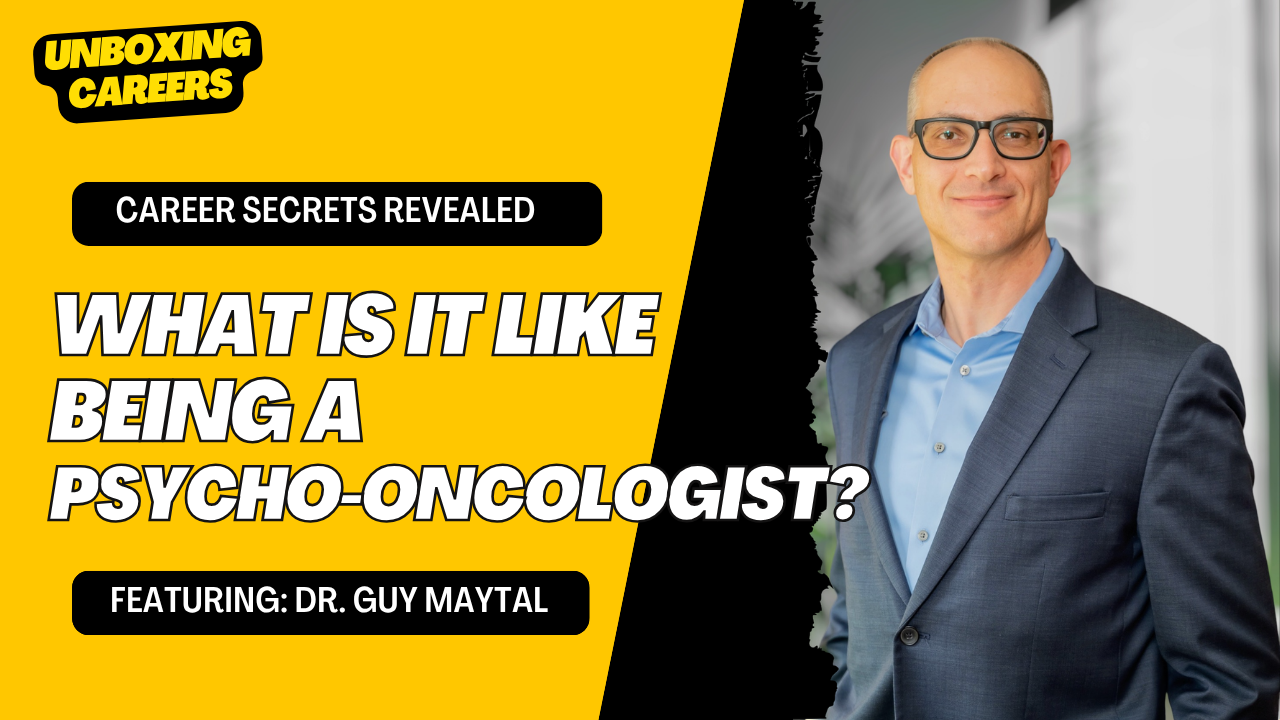
On this episode: Dr. Guy Maytal is a board-certified psychiatrist with more than 20 years of experience working at the intersection of medicine and mental health. Much of his clinical work has focused on supporting patients and families coping with cancer and other serious medical illnesses. He currently serves as Chief Medical Officer at Forge Health, a mission-driven behavioral health organization focused on making high-quality mental health care more accessible.
Listen: Spotify | Apple Podcasts | Amazon Music
What Does a Psycho-Oncologist Actually Do?
Psycho-oncologists focus on the psychological, emotional, and relational spheres of cancer care. The work centers on how people experience cancer, how they feel about themselves during treatment, and how they navigate relationships when everything shifts.
The work isn't limited to people already diagnosed. Some patients carry genetic predispositions to cancer and need to make medical decisions before they're ever sick. A woman with a BRCA gene mutation might be deciding whether to undergo preventive surgery. That conversation involves fear, identity, family planning, and body image, all before cancer enters the picture.
Most sessions don't focus on death. Patients want to talk about what matters to them: their families, careers, hobbies, and grandchildren. Common issues include:
Depression that makes it hard to get out of bed
Anxiety that keeps patients awake at night
Marriage problems that cancer has amplified
Financial stress about treatment costs and lost income
Navigating disability applications and insurance paperwork
Financial concerns appear constantly. Patients worry about paying for transportation to chemotherapy and a babysitter at the same time, knowing they can't afford both.
Who Can Become a Psycho-Oncologist?
Psycho-oncology is unusual because people enter from multiple disciplines:
Licensed Clinical Social Worker (LCSW): Focus on therapy, care coordination, and connecting patients to resources
Psychologist: Provide therapy and psychological testing without prescribing medication
Chaplain: Address spiritual and existential concerns alongside emotional support
Psychiatrist: Offer therapy and medication management with medical training
Each discipline brings different training and tools, but all focus on helping people cope with cancer's emotional and psychological weight.
What Does Training Look Like for Psychiatrists in This Field?
Psychiatry residency provides general training across all psychiatric disorders and treatment settings. Residents rotate through outpatient clinics, inpatient psychiatric units, emergency rooms, and consultation-liaison services where they help medical teams manage patients with both physical and mental health needs.
Those interested in psycho-oncology often gravitate toward consultation-liaison work, which involves working on medical and surgical floors with patients whose physical illnesses trigger or complicate psychiatric conditions.
After residency, specialized training comes through a fellowship at a cancer center. The fellowship year involves:
Working exclusively with oncology patients and their families
Learning how different cancers affect people psychologically
Understanding how treatments like chemotherapy and radiation change mood and cognition
Developing skills for helping people make medical decisions under extreme stress
Training in what not to do, like forcing conversations patients aren't ready for
The fellowship serves as the field's credential, signaling readiness for independent practice.
What Does Daily Work Actually Look Like?
Daily work typically splits between direct patient care and, for some, administrative or leadership responsibilities. The clinical side involves back-to-back therapy sessions, usually scheduled in 45-minute to hour-long blocks. A typical day might include five to eight patient appointments, with brief windows between to document notes and return calls.
Sessions vary widely in content and intensity. One appointment might involve helping someone develop coping strategies for anxiety before their next scan. The next could be processing anger at a spouse who isn't showing up emotionally. Another might focus on practical problem-solving: how to ask for help at work, how to talk to kids about what's happening, or how to navigate disability paperwork.
For psychiatrists, medication management runs parallel to therapy. This means prescribing and monitoring psychiatric medications while watching for interactions with cancer treatments. Dosages need to be adjusted as treatment progresses, and side effects require constant monitoring.
Between sessions, there's documentation. Every appointment requires notes for the medical record. Phone calls come in from patients in crisis, oncology teams requesting urgent consults, or family members trying to coordinate care. Emails pile up with questions about appointments, medication refills, or resources.
For those in leadership roles, the work expands to include:
Building and running psycho-oncology programs
Overseeing clinical teams
Developing protocols for patient care
Teaching medical students, residents, and fellows
Leading case discussions and supervising trainees
What Conversations Actually Happen in Sessions?
The assumption is that psycho-oncology sessions revolve around death and dying. That's rare. Most people don't want to spend their day talking about mortality, and forcing that conversation does more harm than good.
A common session might focus on a patient who isn't getting along with their spouse. Cancer creates stress, and stress reveals cracks. One person wants to talk about the illness constantly; the other wants to pretend everything's normal. Both are coping mechanisms. The psycho-oncologist helps them see that and find a middle ground.
Financial anxiety comes up constantly. Even insured patients struggle with copays, lost income, transportation costs, and childcare during treatment. The psycho-oncologist can't solve the financial problem, but can help patients manage the anxiety layered on top of practical stress. How do you sleep at night when the bills are piling up, and you're also dealing with cancer? That's the work.
Depression shows up frequently. Not sadness about having cancer, but clinical depression that saps energy, ruins sleep, and makes everything feel pointless. Treatment involves a combination of therapy and medication, adjusted as the person moves through different treatment stages.
What Are the Hardest Parts of Psychological Oncology?
1. Dealing with patient helplessness when problems can't be fixed
A patient can't afford both transportation to chemotherapy and childcare. Someone else is losing their home because they can't work during treatment. Another is watching their marriage collapse under the weight of illness. These aren't psychological problems that therapy can solve. The financial strain, the job loss, and the relationship damage are all real.
Your job becomes helping someone cope with an impossible situation while connecting them to whatever limited social services exist. You can't rescue them, and that helplessness accumulates over time.
2. Navigating when to push conversations patients are avoiding
Someone might refuse to talk about advance directives or end-of-life wishes because they're not ready. Pushing too hard damages the therapeutic relationship and makes them less likely to engage. But sometimes decisions need to be made, and the window is closing.
You're constantly making judgment calls about when to let someone avoid a topic because that's their coping mechanism, and when avoidance is creating bigger problems. Getting this wrong in either direction has consequences, and there's rarely a clear right answer.
3. Absorbing emotional weight session after session without letting it flatten you
You're sitting with people at their most vulnerable, hearing fears they don't share with anyone else. One session involves someone sobbing about their kids growing up without them. The next is someone angry at their body for betraying them. Another is describing the humiliation of losing control of basic bodily functions.
You absorb that, session after session, and you have to find ways to process it without becoming numb or overwhelmed. Conversations don't always get resolved. People sometimes stop coming to sessions mid-treatment. Some pass away before you finish the work you started together. That lack of closure is part of the job, and it wears on you.
What Makes Psychological Oncology Work Fulfilling?
As a psycho-oncologist, the privilege of being trusted with people's most vulnerable moments is central to why many stay in this field. Patients share things in therapy they won't tell their spouses, parents, or closest friends. That trust is hard-earned and means something.
For those in academic settings, teaching and training the next generation provides another layer of fulfillment. It's not just about passing on clinical knowledge. It's about shaping how future clinicians show up in the room. Who are you going to be when you sit down with someone who just got diagnosed with stage four cancer?
The work also involves helping people find the resilience they didn't know they had. Someone might walk in convinced they can't handle what's ahead, and over time, they discover they can. Watching that unfold is part of what makes the work worth doing.
Cancer outcomes have improved dramatically. Seventy percent of people diagnosed with cancer in the U.S. are alive five years later. Many patients are managing cancer as a chronic condition or moving into survivorship. The work isn't only about helping people die well; it's often about helping them live well through treatment and beyond.
What Should You Know About Compensation and Work Settings?
Psycho-oncologists typically work in several types of settings:
Academic medical centers: Large teaching hospitals with cancer programs, often including research and teaching responsibilities
Comprehensive cancer centers: Specialized institutes like Dana-Farber or Memorial Sloan Kettering
Community hospitals: Smaller facilities with oncology programs serving local populations
Private practice: Independent practices focused on cancer patients and their families
Integrated care teams: Embedded directly in oncology clinics as part of the treatment team
Compensation varies based on discipline, setting, and geography. Psychiatrists generally earn more than social workers or psychologists due to their medical training and ability to prescribe medication. Academic positions may pay less than private practice but offer teaching opportunities and research support.
The schedule depends on the setting. Private practice offers more control over hours and caseload. Hospital-based roles often involve a mix of scheduled appointments and urgent consults requested by oncology teams. Leadership roles add administrative work, meetings, and program development to the clinical load.
Who is a Psycho-Oncology Career Good For?
People who thrive in psycho-oncology are comfortable sitting with suffering without needing to fix everything. Sometimes your job is just to be present while someone talks about their kids or their hobbies, because that's how they're coping. If you need every session to end with a clear win, this work will frustrate you.
You also need to handle ambiguity. Conversations end mid-sentence. Patients make decisions you wouldn't make. They avoid topics you think are important.
Traits which may indicate success in this career:
Comfort with existential questions about mortality and meaning
Ability to tolerate helplessness when problems can't be solved
Patience with patients' coping mechanisms, even when they seem counterproductive
Interest in the psychological dimensions of serious illness
Capacity to absorb others' emotional weight without becoming overwhelmed
People who struggle tend to be those who can't tolerate situations where they can't rescue someone. When a patient faces an unsolvable problem like catastrophic financial strain, you can only help them cope. Clinicians who need to be the hero find that unbearable.
What Are the Misconceptions About Psycho-oncology?
The biggest misconception is that psycho-oncology is all about death and dying. Most sessions don't touch that. People want to talk about their lives, not their mortality. They're dealing with practical problems, relationship stress, and depression, which makes it hard to function. End-of-life conversations happen, but they're not the daily focus.
Another misconception is that the work is universally depressing. While it involves sitting with suffering, it also involves watching people discover resilience and strength. Cancer doesn't automatically mean death, and many patients move through treatment into survivorship.
Some people assume you need to be a psychiatrist to do this work. Social workers, psychologists, and chaplains also practice psycho-oncology. Each brings different training, but all can do meaningful work in this space.
Closing Perspective on the Psycho-Oncologist Career
Psycho-oncology involves sitting with people during one of the hardest experiences of their lives, helping them manage depression, anxiety, relationship strain, and practical challenges that can't always be fixed. Days are spent in therapy sessions addressing what actually matters to patients, prescribing and managing medications when appropriate, and navigating the gap between what people need and what's available.
The work requires comfort with ambiguity, tolerance for helplessness, and interest in the psychological dimensions of serious illness. If you're drawn to helping people find ways to cope when life becomes overwhelming, and you can handle the emotional weight that comes with that, this career offers meaningful work at the intersection of medicine and human experience.
Frequently Asked Questions
What is the difference between a psycho-oncologist and a regular therapist?
Psycho-oncologists specialize in the psychological challenges specific to cancer. They understand how different cancers and treatments affect mental health, how to help people make medical decisions under extreme stress, and how to address the unique issues that arise during cancer care.
Do you need to be a psychiatrist to work in psycho-oncology?
No. Psycho-oncologists come from multiple disciplines, including psychiatry, psychology, clinical social work, and chaplaincy. Psychiatrists can prescribe medication. Psychologists focus on therapy and testing. Social workers often help with care coordination.
What kind of training do you need to become a psycho-oncologist?
The psychiatry route requires medical school, a four-year psychiatry residency, and a one-year fellowship in psycho-oncology at a cancer center. Other routes involve master's or doctoral programs in psychology or social work, followed by specialized training in oncology settings.
Do most psychological oncology therapy sessions focus on death and dying?
No. Most sessions address practical and emotional challenges like depression, relationship problems, anxiety about treatment, families, careers, and financial stress.
What makes psycho-oncology work emotionally difficult?
The work involves sitting with suffering you often can't fix. Patients face problems like financial strain, relationship breakdowns, and physical decline that therapy alone can't solve. You absorb their fears and grief session after session. Some patients stop coming mid-treatment or pass away before you finish the work together.
Interested in other healthcare and mental health careers? Check out these episodes:
Listen on: Spotify | Apple Podcasts | YouTube | Amazon Music
Interested in being a guest or partnering with us? Contact us here.