53 Thanatologist
What a Career as a Thanatologist is Like?
A thanatologist works at the intersection of death, dying, grief, and loss, applying clinical practice and research to support people through some of life’s most difficult experiences. The work spans pediatric hospice rooms, grief counseling centers, academic programs, and community-based end-of-life care.
Dr. Korie Leigh, a certified thanatologist and fellow with over 22 years in end-of-life work, breaks down what this career actually looks like.
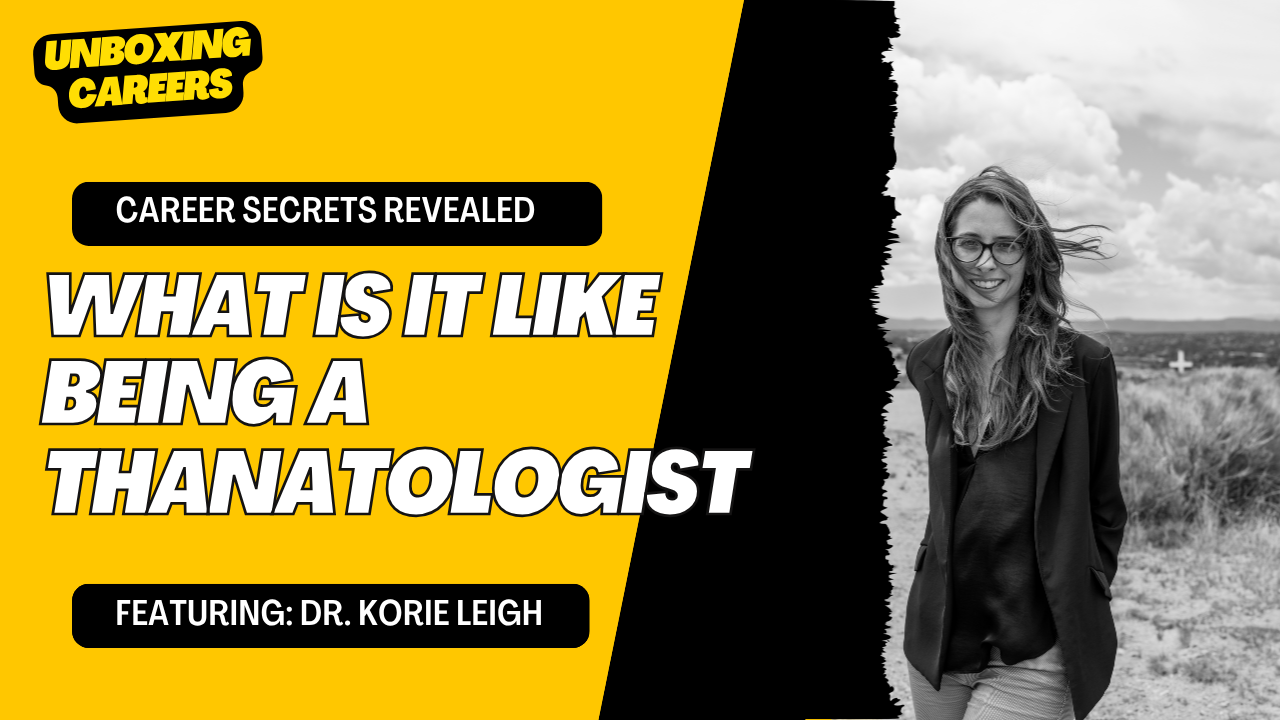
Guest: With over two decades of clinical experience as a certified child life specialist and thanatologist, Dr. Korie Leigh is a nationally and internationally recognized expert in childhood bereavement, trauma-informed care, and compassionate communication. She specializes in supporting children and families navigating illness, death, and loss. She is the director of the Thanatology program at Marian University and the author of three books on grief and loss for children and families.
Connect with Dr. Leigh:
Listen: Spotify | Apple Podcasts | Amazon Music
What Is a Thanatologist and What Does the Field Cover?
Thanatology is the multidisciplinary study of death, dying, grief, and loss. The name comes from Thanatos, the Greek god of death, combined with “ology” (the study of). It’s a broad field that touches medicine, psychology, social work, chaplaincy, art therapy, and more.
What makes thanatology different from simply working in hospice or grief counseling is that it provides a scientific and theoretical framework for understanding how death and loss affect people. Practitioners don’t just comfort the grieving. They draw on evidence-based research to guide their approach, understand trauma responses, and apply developmental theory to how different populations (children, the elderly, families) process death.
The field looks different depending on where you practice. In the United States, thanatology is treated as an applied practice. Practitioners take theories and concepts and use them directly in clinical work with people who are dying or grieving, or they conduct research that directly informs clinicians. In Europe, the field tends to be more philosophical. Practitioners might study the linguistics of how people talk about death, the sociology of how communities interact with graveyards, or the anthropology of dying rituals in indigenous cultures.
What Are the Different Career Paths Within Thanatology?
One of the most distinctive things about thanatology is how many entry points it has. There is no single career track. The field attracts people from vastly different backgrounds, and the work they do once they arrive looks different depending on what they bring with them.
Some common paths include:
Clinical practitioners: Social workers, chaplains, nurses, doctors, and therapists who want to specialize in end-of-life or grief work. They already have a clinical foundation and use thanatology training to deepen their expertise.
Career changers: People from entirely unrelated fields (marketing, finance, mathematics) who experienced a personal loss that changed their sense of purpose. They typically need a full master’s degree because they lack the foundational psychology and developmental theory background.
Death doulas: A growing but completely unregulated role. Someone can take a weekend workshop and call themselves a death doula, which raises serious ethical concerns when working with vulnerable populations. Formal thanatology training provides the evidence base, ethical grounding, and supervised practice that a weekend certification cannot.
Community-based and creative practitioners: Artists, fiber artists, musicians, and others who want to use expressive modalities to support the grieving. One student created an art studio specifically using fiber arts to help people process grief.
Researchers and academics: Those interested in studying how people die, grieve, and cope, and producing research that influences clinical practice.
Career advancement typically comes through the underlying profession (social work, chaplaincy, nursing) rather than through thanatology itself. Thanatology functions as a specialization layered on top of an existing career, giving practitioners a deeper lens for end-of-life and grief work.
What Education and Credentials Do You Need to Become a Thanatologist?
There are only a handful of dedicated thanatology academic programs in the country. The degree options currently available include a Master of Science in Thanatology, a postgraduate certificate, and (more recently) a Bachelor of Science in Thanatology.
For students considering their undergraduate path, the general recommendation is not to major in thanatology at the bachelor’s level, even at schools that offer it. A stronger foundation comes from majoring in something like psychology, social work, art therapy, or counseling, because thanatology builds directly on developmental theory and clinical frameworks taught in those programs. Students who enter a thanatology master’s program without that background often have to go back and teach themselves foundational theories (Freud, Bronfenbrenner’s ecological systems theory) that psychology undergrads already know.
To become a certified thanatologist (CT), you need:
A certain number of graduate-level educational credits in relevant coursework
Approximately 3,000 hours of practice experience
A passing score on the certification exam offered through ADEC (the Association of Death Education and Counseling)
After practicing as a CT for several years, there is an optional path to becoming a fellow in thanatology. Fellowship recognizes sustained contribution to the field through teaching, research, publishing, and community service. It essentially signals that a practitioner has been active in the profession for a decade or more and is giving back to the field.
How Do You Get Hands-On Experience Before Committing to the Field?
The single most recommended first step for anyone considering this career is to volunteer at a local hospice. This applies regardless of background. Whether you’re a social worker wanting to specialize or a marketing professional making a complete career change, hands-on experience with people at the end of life is essential before committing to formal education.
Hospice volunteering provides several things you cannot get in a classroom:
Structured training from the hospice organization itself
Continual support and supervision from experienced staff
A built-in team of people doing the same work
A realistic sense of whether this work is actually a fit for you
That last point matters more than people expect. Some students enter thanatology programs and begin their volunteer hours only to realize, a month or two in, that the work isn’t what they imagined. Discovering that before investing in a full degree is valuable. If grief and loss are the focus rather than end-of-life care, grief centers (particularly children’s grief centers, even for those who don’t plan to work with kids) offer a similar hands-on, supervised experience.
When evaluating a hospice volunteer program, there are a few things worth asking about:
How long is the volunteer training, and how many hours does it involve?
What kind of ongoing support and continued training will you receive?
What kind of evaluation process exists?
Organizations that invest in structured training, ongoing support, and evaluation tend to provide a much better learning experience than those that simply place volunteers without follow-up.
What Does a Typical Day Look Like in Thanatology?
There is no single typical day because the work depends heavily on the setting and the practitioner’s underlying profession. But the common thread across settings is direct, emotionally intensive contact with people who are dying, grieving, or both.
In a pediatric hospital setting, the work might involve:
Helping children understand what’s happening to their bodies and why
Preparing patients for medical procedures using play, art, and music
Supporting siblings and parents as they cope with a child’s illness or death
Working with children who are actively dying and their families
In a hospice setting, the rhythm is different. Teams tend to be more experienced with death as a daily reality, and the environment often provides stronger support structures. Practitioners describe hospice work as more sustainable emotionally, not because the content is easier, but because the organizational culture is built around supporting the people who do it.
In an academic role, the day shifts toward teaching graduate students, supervising their clinical placements, reviewing research, and developing curriculum. But even academic thanatologists typically maintain some form of clinical contact, whether through consulting, supervising practitioners, or engaging directly with grieving communities.
What Are the Essential Skills for Working in End-of-Life and Grief Care?
The skills that matter most in this field are not technical. They are relational and internal. The three most critical, according to Dr. Leigh:
Self-reflection: The ability to recognize what you feel, why you feel it, when it comes up, and what you do with it. This is foundational. Without self-awareness, practitioners risk projecting their own unresolved grief onto clients or burning out without recognizing the warning signs.
Curiosity and compassionate listening: Even with credentials and experience, each family and each death is different. The practitioner has to show up without assumptions, listen without an agenda, and stay open to what this particular person needs in this particular moment.
Attunement: The awareness that your nervous system affects the people around you. If talking about death makes you visibly anxious, patients (especially children) will pick up on it. Learning to regulate your own responses so that you can be a calming presence rather than an anxious one is a skill that develops with practice, not just study.
Critical thinking also matters. Practitioners need to evaluate research studies, identify what applies to the specific population they’re working with, recognize limitations in the evidence, and adapt accordingly. Reading a study and applying it are very different skills.
What Is the Emotional Toll of Working with Death and Grief Every Day?
Compassion fatigue, burnout, and vicarious trauma are all occupational hazards of this field. They are not possibilities to be aware of. They are near-certainties to be managed.
The rate of burnout is particularly high in hospital settings, and moral distress (the feeling of knowing what the right thing to do is but being unable to do it) compounds the problem for early-career practitioners. Programs are getting better at teaching coping mechanisms, but the reality is that you cannot fully prepare for the emotional impact until you experience it. You can read about it, do role plays in graduate school, and talk about it in class. Then you leave a hard shift and sit alone with physical sensations and emotional responses that theory didn’t prepare you for.
Dr. Leigh experienced this directly. She became vicariously traumatized working in a hospital setting and left the field entirely for a period. She considered not coming back. At the time, she had the academic knowledge about self-care and coping, but the tools she’d been taught weren’t enough to address what she was actually experiencing.
What changed was the environment. Moving from a hospital into hospice was, in her words, “night and day.” The hospice team understood boundaries, supervision, and the importance of supporting the people doing the work. There is something fundamentally different about working alongside colleagues who have witnessed and facilitated death daily. It changes the way people show up.
The strong recommendation for anyone entering this field is to have a therapist, even if only short-term. Self-care alone is not sufficient to combat the real trauma that practitioners witness. The distinction matters: self-care (exercise, rest, hobbies) maintains baseline well-being, but it doesn’t process trauma. Professional support does.
What Are the Biggest Misconceptions About Working in Thanatology?
The most common misconception is that the field is uniformly dark or depressing. People hear “study of death” and assume every day is heavy. The reality is more nuanced. Many practitioners describe the work as deeply life-affirming. Being present with people at the end of their lives and helping families find ways to cope often makes practitioners more present and tuned in to their own lives outside of work.
Another misconception involves the death doula role specifically. Because the profession is completely unregulated, someone can take an eight-hour weekend workshop and begin practicing. This is ethically problematic when working with vulnerable populations. Formal credentials (a CT certification, a relevant master’s degree) don’t just add letters after your name. They provide the evidence base, ethical training, and supervised hours that protect both the practitioner and the people they serve.
There’s also a misconception about who enters the field. It’s not exclusively people with medical or clinical backgrounds. Students range from social workers and chaplains to fiber artists and finance professionals. The oldest student in one program was 86 years old, enrolled because they wanted to leave their family a legacy around death that wasn’t shrouded in trauma. The field is broader and more accessible than most people assume.
Is There a Growing Demand for Thanatology Professionals?
Yes, particularly for credentialed practitioners. As the population ages and conversations around end-of-life care become more mainstream (including ongoing debates around medical aid in dying), the need for professionals with formal training in death, grief, and loss is increasing.
The emphasis on credentials is important. The field is still young enough that legitimacy is being established. Practitioners who hold a CT certification, a relevant graduate degree, or both are positioned to stand apart from the growing number of uncredentialed practitioners entering the space. Credentialing protects communities, provides legitimacy to the profession, and signals a level of preparation that a weekend workshop cannot match.
Thanatologist Career Snapshot
Who thrives: People with deep self-awareness, high empathy, and a genuine comfort with sitting in discomfort. Information-based copers who respond to emotional intensity by wanting to understand it rather than avoid it. Those who find purpose in presence, not in fixing, and who can sustain emotional engagement over years without losing themselves in it.
Who struggles: Anyone who hasn’t done their own grief work or who avoids emotional discomfort. People who need to fix or solve every problem will find this work frustrating, because much of it involves being present with pain rather than resolving it. Those without strong self-reflection skills are at high risk of burnout and vicarious trauma.
Key tradeoffs: The work is emotionally intensive, and the occupational hazards (compassion fatigue, vicarious trauma, burnout) are real. The field is still niche, with limited dedicated academic programs and an unregulated death doula market that can create confusion about professional standards. Career advancement typically comes through the underlying profession (social work, nursing, chaplaincy) rather than through thanatology itself.
Closing Perspective on the Thanatology Career
Life as a thanatologist is built around being present with people during the moments most others look away from. The days involve sitting with families as they lose someone, teaching students the science behind grief, supervising new practitioners as they encounter death for the first time, and continually managing your own emotional responses to work that never stops being heavy.
The field rewards curiosity, self-reflection, and a willingness to sit in discomfort without trying to fix it. It punishes those who skip the internal work, who enter without supervised experience, or who underestimate the cumulative toll of daily exposure to loss. The emotional weight is real, the burnout risk is high, and self-care alone won’t protect you.
For those drawn to it, the work offers something rare: a career that makes practitioners more present and more attuned in their own lives, not less. The question is whether you can sustain that engagement over the years, and whether you’re willing to invest in the credentials, the supervision, and the personal work that the career demands in return.
Frequently Asked Questions
What is a thanatologist?
A thanatologist is a professional who works in the multidisciplinary field of death, dying, grief, and loss. The work can be clinical (sitting with dying patients, counseling the bereaved), academic (teaching and research), or community-based (facilitating death-positive spaces, training hospice volunteers).
How do you become a certified thanatologist?
Certification requires graduate-level coursework, approximately 3,000 hours of supervised practice, and passing an exam through ADEC (the Association of Death Education and Counseling). After several years of certified practice, practitioners can pursue fellowship status.
Do you need a medical degree to work in thanatology?
No. Many thanatologists come from clinical backgrounds (social work, nursing, chaplaincy), but the field also attracts career changers from unrelated fields. Those without a clinical or psychology background typically need a full master’s degree to build foundational knowledge, while those with a relevant graduate degree may only need a postgraduate certificate.
What is the hardest part of working in thanatology?
The emotional toll. Compassion fatigue, burnout, and vicarious trauma are occupational hazards, not remote possibilities. Burnout rates are especially high in hospital settings.
Is a death doula the same as a thanatologist?
A death doula supports people through the dying process, but the profession is completely unregulated. Someone can take a weekend workshop and begin practicing. A certified thanatologist has completed graduate-level coursework, logged thousands of supervised hours, and passed a credentialing exam.
Interested in other healthcare and mental health careers? Check out these episodes:
Listen on: Spotify | Apple Podcasts | YouTube | Amazon Music
Interested in being a guest or partnering with us? Contact us here.