55 Hematology-Oncology
What Is It Like Being a Hematologist/Oncologist?
Hematologist-oncologists diagnose and treat blood cancers like multiple myeloma, leukemia, and lymphoma, managing patients through diagnosis, chemotherapy, immunotherapy, and end-of-life decisions. The work involves clinic visits with patients at every stage of their cancer journey, ordering bone marrow biopsies and PET scans, and rotating through hospital bone marrow transplant units where doctors are on call day and night. Many also run clinical trials, conduct cancer research, and teach medical students and residents. Here's what the day-to-day work actually looks like.
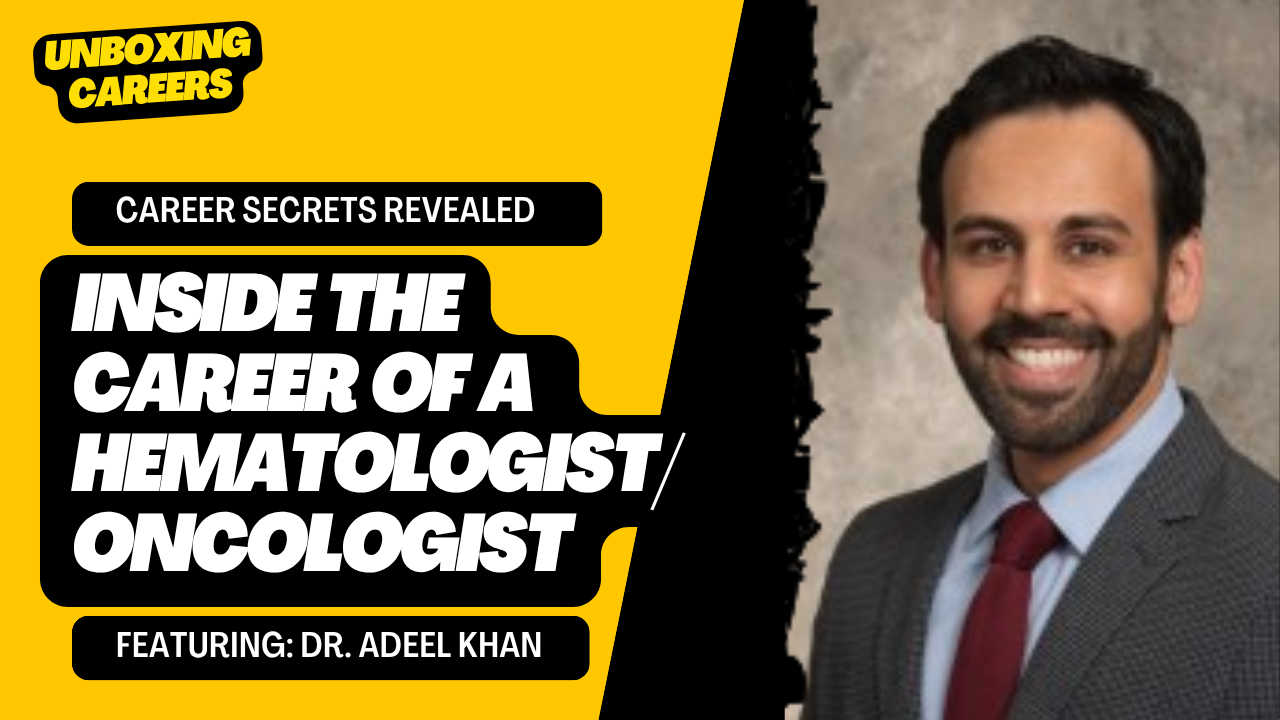
Today’s Expert: Dr. Adeel Khan is an academic Hematologist/Oncologist and Epidemiologist. He serves as an Assistant Professor of Medicine and Public Health at the University of Texas Southwestern Medical Center in Dallas. He also serves as the Director of Myeloma Epidemiology Research and Clinical Director of the Monoclonal Gammopathy Precursor Clinic. He is a graduate of the University of Michigan Medical School, Harvard T.H Chan School of Public Health, and Columbia Mailman School of Public Health.
Connect with Dr. Khan:
Listen: Spotify | Apple Podcasts | Amazon Music
What Does a Hematologist-Oncologist Actually Do?
Hematologist-oncologists focus on cancers of the blood and the study of blood itself. This includes diseases like multiple myeloma, leukemia, lymphoma, and anemia. The work involves diagnosing these conditions, managing treatments, and supporting patients through every stage of their journey.
Multiple myeloma is one example of the diseases treated in this field. It's a cancer of plasma cells, a type of white blood cell that lives in bone marrow and produces antibodies. When patients come to clinic, they're either being evaluated for a possible diagnosis or already living with the disease and receiving ongoing treatment.
Treatment options have expanded significantly over the past decade. Hematologist-oncologists work with:
Chemotherapy regimens for actively progressing disease
Immunotherapies that use the immune system to attack cancer cells
Targeted therapies that block specific cancer pathways
Bone marrow transplants for eligible patients
Clinical trials offering access to newer treatments
While many blood cancers were once considered death sentences, treatment advances have dramatically improved outcomes. Multiple myeloma survival rates have more than tripled, and conditions like chronic myeloid leukemia can now be managed with targeted drugs that give patients near-normal life expectancy.
How Do You Become a Hematologist-Oncologist?
The path is long and structured. Most hematologist-oncologists follow this timeline:
Four years of undergraduate education
Four years of medical school
Three years of residency in internal medicine
Three years of fellowship in hematology-oncology
Internal medicine residency provides broad training across all adult medical specialties, from cardiology to endocrinology. The hematology-oncology fellowship that follows focuses specifically on cancer care and blood disorders, providing the specialized training needed for independent practice.
Some hematologist-oncologists add additional training. A degree in public health, for example, can support work in cancer epidemiology and population-level research. This expands career options into research-focused roles at academic institutions.
What Does Daily Work Actually Look Like?
A hematologist-oncologist's week typically blends clinical care with other responsibilities. For those in academic medicine, the schedule might break down like this:
Two days per week in clinic seeing patients
One week out of every six is spent in the hospital on bone marrow transplant service
Remaining days dedicated to research, administrative work, and teaching
When on hospital service, the work is intense. Doctors cover all blood cancer patients on the unit for seven straight days, take calls during the day and night for emergencies, and rotate the responsibility with colleagues.
Research and administrative days look very different. These involve working with large data sets on a computer, responding to email, joining Zoom calls, and managing the back-end work that keeps clinical care running. Teaching also fits into this mix, including supervising clinical fellows, internal medicine residents, and medical students during clinical work, and leading formal seminars throughout the year.
What Happens in a Typical Clinic Day?
Clinic days involve seeing patients at every stage of their cancer journey. A single morning might include:
A new patient with concerning lab results is being evaluated for a possible blood cancer diagnosis
Someone newly diagnosed who needs treatment planning and education
A patient on active chemotherapy is being monitored for response and side effects
Someone with relapsed disease needing advanced treatment decisions
A patient nearing end of life, requiring goals-of-care conversations and possibly hospice referrals
Diagnosis often requires bone marrow biopsies, PET scans, MRIs, and detailed lab work. Once a diagnosis is confirmed, treatment plans are built around the specific disease, the patient's overall health, and their goals.
The relationships in this field run deep. Patients with diseases like multiple myeloma often see their hematologist-oncologist for years, sometimes decades. Conversations naturally extend beyond medical updates into discussions about family, work, and life events. That bond becomes part of the work.
What Career Paths Exist With This Specialty?
The hematology-oncology training opens doors to several distinct career models:
Full-time clinical practice: Seeing patients in clinic day in, day out, treating a wide range of cancers, including breast, lung, and blood cancers
Hospital-based practice: Focusing exclusively on inpatient care
Academic medicine: Combining clinical work with research, teaching, and clinical trials
Industry research: Working for pharmaceutical companies on drug development and laboratory science
Clinical trial management: Designing and overseeing studies that test new treatments
Managed care: Working for insurance companies to review treatment decisions and care quality
Academic positions often allow for the widest variety, blending patient care with research and teaching. Private practice tends to focus more heavily on clinical work but may offer different compensation structures and lifestyle considerations.
Hematology-oncology Compensation
Hematologist-oncologists are generally well compensated, but the structure varies significantly based on practice model. Academic physicians typically earn less than those in private practice. They're paid one annual salary that covers clinical work, research, teaching, and administrative duties, with some fluctuation based on performance metrics.
Additional income for academic doctors can come from grant funding, speaking honoraria, and paid talks. The tradeoff is that academic salaries are relatively predictable and don't require chasing revenue patient by patient.
Private practice compensation is more directly tied to clinical volume and revenue generation. Doctors in this model often earn more but spend more energy on billing and productivity metrics. Some take on additional roles like adjunct teaching positions, which pay separately based on hours worked.
The general saying in medicine is that compensation is strong enough that you'll "die with money in the bank." That makes it easier to choose work based on interest and impact rather than purely financial return.
What Is Work-Life Balance Like in This Career?
Doctors are not famous for work-life balance. A more accurate framing is work-life negotiation. Some weeks demand intense focus on work, particularly during hospital rotations. Other weeks allow more space for family and personal time.
Hospital weeks are unavoidable in their intensity. Being on call day and night means responding to emergencies whenever they arise. Clinic weeks have more predictable hours but still involve patient calls, documentation, and the mental load of carrying serious cases.
Achieving balance requires intentional choices. Hematologist-oncologists generally have control over which research projects to pursue, how much teaching to take on, and what administrative roles to accept. Over time, most build a schedule that fits their priorities, though the structure of the field means complete balance is rare.
What Are the Hardest Parts of This Work?
1. Watching patients you've known for years decline
In hematology-oncology, relationships with patients often span years. You learn about their families, their work, and their grandchildren. When their disease starts to progress, usually gradually rather than suddenly, that decline is hard to watch.
The emotional cost is real. You've invested in their story, and watching it end takes something out of you. The mentor's advice that often gets passed down: care enough that you never lose your humanity, but not so much that you lose your sanity.
2. Navigating insurance and administrative red tape
A significant portion of the work involves fighting for treatment approvals. Insurance companies often deny coverage for cancer treatments, especially newer therapies and clinical trial-related care.
Hematologist-oncologists spend considerable time on peer-to-peer calls with insurance company doctors, submitting prior authorizations, and writing appeals. Most cases eventually get approved, but the friction is constant and frustrating. The administrative bloat takes time away from patient care and can delay treatments that patients need urgently.
3. Managing the emotional weight while staying clinically sharp
The field requires sitting with people facing serious illness, sometimes terminal diagnoses, and making complex treatment decisions under pressure. You have to bring full attention to each patient while carrying the cumulative weight of everyone else on your caseload.
End-of-life conversations are part of the work. Helping patients and families navigate hospice decisions, goals of care, and quality-of-life tradeoffs requires emotional steadiness over years of practice.
What Makes This Work Rewarding?
As a hematologist-oncologist, watching patients turn around on treatment is one of the most satisfying parts of the work. Someone might come in with uncontrolled multiple myeloma, kidney failure, severe anemia, and high calcium levels, feeling terrible and barely functioning. After starting treatment, they often improve dramatically. They regain energy, return to normal activities, and express genuine appreciation for the care.
The field is also one of the most rapidly advancing in medicine. Cancer research has received substantial funding and attention over the past several decades. What were once death sentences have become controllable diseases. New drugs, new immunotherapies, and new targeted therapies emerge regularly. Being part of that progress, sometimes through clinical trials that directly benefit patients, makes the work feel meaningful.
For those in academic settings, teaching adds another layer of fulfillment. Training the next generation of hematologist-oncologists, supervising fellows, and shaping how future clinicians approach this work creates impact beyond individual patient care.
The relationships matter too. Spending years with patients, getting to know their families, and being present during some of the most significant moments in their lives builds connections that few other careers offer.
How Is AI Changing This Field?
AI is showing up in cancer care in several ways. Many hematologist-oncologists use large language models for casual research tasks, similar to advanced searching. More substantively, AI tools are being explored for receptor analysis, network meta-analyses, and other computationally intensive research questions.
The technology remains in its early stages for clinical use. There's ongoing discussion about whether AI will replace certain roles, particularly in radiology and pathology, where pattern recognition matters most. Hematology-oncology is somewhat protected from that concern because the work depends heavily on patient relationships.
The phrase that captures the limit of AI in this field is "artificial empathy." A patient navigating a cancer diagnosis needs a human connection that current AI can't replicate. Treatment decisions involve not just clinical data but values, preferences, and the kind of trust built over years of conversations. That human element is unlikely to be automated anytime soon.
What Misconceptions Exist About This Career?
The biggest misconception is that you need a perfect "calling" to pursue this field. Many students wait for lightning to strike, looking for the one specialty that checks every box and creates no hesitation. That clarity rarely exists.
Most hematologist-oncologists picked the field because they found it interesting, knew they didn't want to be surgeons, and felt drawn to the science. They acknowledged the imperfect parts, made the choice, and grew to love the work over time. The expectation of a flawless calling can actually delay good decisions.
Another misconception is that academic medicine pays poorly compared to private practice. While academic salaries are lower, they're still substantial, and the tradeoffs often favor academic settings for those who value research and teaching. The compensation in this field is strong enough across all practice models that most physicians don't need to optimize purely for income.
A third misconception is that oncology is universally depressing. The field involves serious illness, but many patients improve dramatically with treatment. Survival rates have climbed across most cancers. Watching people regain their lives is a regular part of the work, not an exception.
Closing Perspective on the Hematologist-Oncologist Career
Hematology-oncology involves treating people through some of the most serious diagnoses they'll ever receive, building relationships that span years, and balancing clinical care with research, teaching, and administrative demands. Days move between clinic appointments, hospital rotations, data analysis, and the constant background work of fighting insurance approvals and managing complex treatment plans.
The work requires emotional steadiness, scientific curiosity, and comfort with both rapid breakthroughs and unavoidable losses. If you're drawn to a field where treatment advances are dramatically extending lives, where relationships with patients run deep, and where you can shape your career across clinical work, research, and teaching, this specialty offers meaningful work with substantial impact.
Frequently Asked Questions
How long does it take to become a hematologist-oncologist?
The path typically takes 14 years: four years of undergraduate education, four years of medical school, three years of internal medicine residency, and three years of hematology-oncology fellowship.
What's the difference between hematology and oncology?
Hematology is the study of blood and blood disorders, including blood cancers like leukemia, lymphoma, and multiple myeloma. Oncology is the broader study and treatment of cancer. Most physicians train in both, becoming hematologist-oncologists who can treat blood cancers and other types of cancer.
Is multiple myeloma curable?
Multiple myeloma is not curable, but treatment advances have more than tripled survival rates. Many patients live for years or decades with the disease, managing it as a chronic condition through chemotherapy, immunotherapy, and targeted treatments.
Do hematologist-oncologists in academic settings make less money?
Yes, academic hematologist-oncologists generally earn less than those in private practice. The tradeoff is access to research opportunities, teaching, clinical trials, and a more predictable salary structure not tied to patient volume.
Interested in other healthcare and mental health careers? Check out these episodes:
Listen on: Spotify | Apple Podcasts | YouTube | Amazon Music
Interested in being a guest or partnering with us? Contact us here.